
Signed in as:
filler@godaddy.com
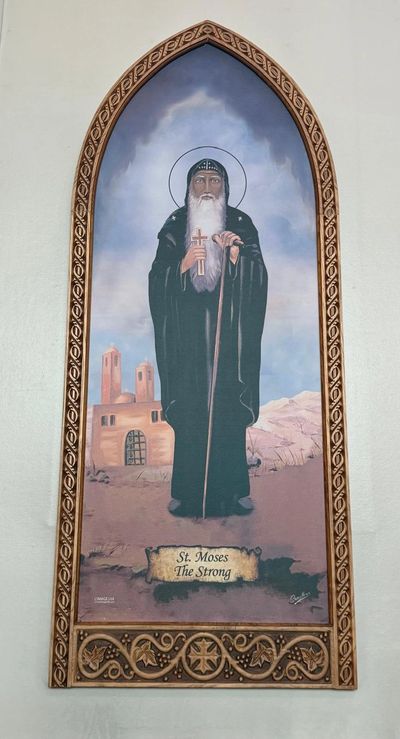
St. Moses was born about 332 AD. In his youth, he was the slave of a high government official who could not tolerate St. Moses’ dishonesty and violence. It was even said that St. Moses went so far as to commit murder. Finally, his master drove him out of his house. St. Moses became the head of a gang of seventy robbers. He was a strong and fierce man of huge stature
Once, as he was walking along the banks of the Nile, he spotted some sheep and a shepherd on the opposite side of the Nile. The Nile at that time was at full flood and more than a mile wide. St. Moses put his sword between his teeth and swam across the river. When the shepherd saw him, he ran away and buried himself in the sand. The sheep were left for St. Moses, who chose four of the best rams, slew them and tied them with a rope. He then carried them on his back and swam back across the river. He came to a small village where he skinned the rams, ate the best portions of them, and sold the rest for wine.
The specific circumstances regarding St. Moses conversion are not known. It was mentioned that St. Moses used to address the sun saying, If you are god let me know, and You the God whom I know not, lead me to You. St. Moses heard from someone that the monks in the wilderness of Scetis knew God, so he immediately girded himself with his sword and went to the wilderness.
When St. Moses was seen next, he was in Scetis in the western desert of Egypt. An elder found him and led him to St. Macarius the great at Petra in the northern end of Scetis. It was about 365 AD when St. Moses arrived there. At that time, thousands of monks had followed St. Macarius after he came to that area in the year 340 AD.
St. Moses was received by one of the priests of Scetis, St. Isidore. He was fortunate enough to have such an experienced and pious elder as his spiritual guide and director. St. Isidore led St. Moses safely during a very turbulent time in his life. As a catechumen, St. Moses received the basic Christian teachings from St. Isidore. However, the Divine Light was too much for the newly converted St. Moses, who was heavily burdened with sin. Frequently, he exploded in tears, and had to find relief in kneeling before his guide, St. Isidore, and confessing his sins. When the time for his baptism came, St. Moses confessed all his past evil deeds publicly in the church. During his confession, St. Macarius saw a tablet that was all black representing the sins of St. Moses. An angel was seen wiping off every sin as it was confessed by St. Moses, until finally the tablet was completely white.
For St. Moses, the white robe he received after baptism, and the monastic lifestyle did not mean that he entered into the paradise of contemplation. On the contrary, he had in front of him many years of strife and fierce struggle with the flesh, the devil and the world. Although he was surrounded by giants of the spiritual life whose counsel he could seek at any time, and was aided by the church Mysteries and means of grace, yet it was with utmost difficulty that he won the long successive and violent battles of the flesh. After he came to the desert, St. Moses still enjoyed his former bodily strength, but his old evil passions were as powerful as before. Once, after St. Moses fasted seven days, he overpowered four thieves who entered his cell. He tied them all together with cords and lifted them up on his shoulders like a bag of straw. He brought them to the church and said to the monks, Since I have not the power to do evil to any man, what do you want me to do with these who rose up against me to slay me? When the thieves knew that St. Moses was a former robber, who had repented, they were quickly led to repentance.
While fasting, and during times of prayer, the devil tempted St. Moses by bringing back to his mind his wicked habits of his past. St. Moses used to go to St. Isidore to ask for his advice on what to do. At first, St. Isidore advised him to stand firm and continue his fasting and prayers, and his temptations would finally subdue. St. Isidore told St. Moses that these temptations were only the beginning of a long battle.
St. Moses began to multiply his disciplines. He ate only ten ounces of dry bread daily and recited fifty prayers every day. Nevertheless, the more St. Moses dried up his body, the more he was vexed and consumed by dreams. On one occasion, it came to the point that St. Moses could no longer endure being in his cell. St. Isidore advised him to return to his cell, but St. Moses refused. St. Isidore took St. Moses to the roof of his cell, where they could see below them devils on one side, but innumerable angels on the other side. By seeing this, St. Moses was convinced that he had much more help from heaven as compared to the power of the enemy. He took courage from this and returned to his cell without fear.
St. Moses went to another one of the desert fathers and asked him What shall I do, for thoughts of lust which arise from my former habits are attacking me. St. Moses was advised to increase his prayers, vigils and fasting in order to dispel those images from his mind. St. Moses took the advice, went back to his cell, and for seven years, plunged himself into severe ascetic practices. St. Moses spent nights standing in prayer and would not lie down, or even bend his knees or close his eyes. After this, he would go in the middle of the night to the cells of the elder monks, take their water pitchers, and fill them with water without their knowledge. The monks lived far from one another and those cells were two to five miles away from the water. St. Moses consumed his body doing this for years, with long vigils and strict fasts, until one night St. Moses lost his consciousness and fell beside the water well. The next morning he was found half dead by one of the brethren and was carried to church. During his sickness that lasted for one year, he was taken care of by St. Isidore. He advised St. Moses to give himself rest because, There is moderation in everything, even in the works of ascetic life.
Still, St. Moses disputed with his spiritual father and insisted on continuing to wage war with the devils until they departed from him. The wise and experience St. Isidore gave him this conclusive answer: In the name of Jesus Christ, from this point forward the devils shall cease from you. Draw near then and participate in the Holy Mysteries, and you shall be free from all impurity, both of the flesh and of the spirit. With this, St. Moses returned to his cell. St. Isidore came to him after two months and asked about his condition. St. Moses reported he no longer suffered from anything; moreover, he even had power over the demons.
St. Moses became very famous among the monks of Scetis because of his humility, his meekness and his love for strangers. His solitude was frequently interrupted by the influx of visitors. He went to St. Macarius and said, Father, I desire to live in silence, but the brethren never leave me. St. Macarius advised him to move to an isolated cell in Petra. Petra (literally rock) is the northern area of Scetis. It was a far area, difficult to reach, with scarce water. St. Moses lived in Petra for six years in a cave that he dug for himself in the rock. He became known as Abba Moses of Petra.
St. Moses was later chosen to become a priest in Scetis to assist St. Isidore. Pope Theophilus ordained him a priest, and after St. Moses was dressed in the white priestly garments, Pope Theophilus stated, Behold, Abba Moses, now you are entirely white, inside and out.The grace of God worked in Moses to the extent that as much as he hated humankind before his conversion, in Scetis he came to love everybody. He received all visitors with joy. Once a brother came to visit St. Arsenius in the monastery. Offended by the cold reception he received, he then asked to see St. Moses who did not fail to welcome and refresh him. On another occasion, a private fast was declared in Scetis. During that week of fasting, some brethren came from Egypt to see St. Moses. While St. Moses was preparing some food for them, the neighboring monks saw the smoke of his fire rising up and wondered how St. Moses could not keep the fast. They went to the clergy and said Moses has broken the commandment and prepared food during a fast. The clergy promised to settle the matter with St. Moses in church. The clergy knew of the habits of St. Moses, and when he came to church, they spoke to him before the whole assembly of monks saying, O Abba Moses, truly you have sacrificed the commandment of people to fulfill the commandment of Christ: A new commandment that I give unto you, that you love one another; as I have loved you, that you also love one another. (John 13:34)
Once the Fathers of the Scetis were holding a council to reprimand a monk who had committed a fault. St. Moses was invited, but he refused to attend. The priest went to him, and said, Come, for the people are expecting you. St. Moses arose, took a basket filled with sand that had a hole in the bottom of it, carried it on his shoulder and started walking towards the council. When the monks saw him coming with the bag of sand, with sand pouring out of the hole, they asked him the reason of his behavior. He said to them, The sand you see running from the bag represents my sins which are always following me, and yet, today I am coming to judge the errors of my brother. When they heard this, they left the council and every monk went to his own cell, as none could judge that monk.
About 370 AD, St Moses, St. Evagruis, St. Cronius, St. Pambo and three other Desert Fathers went to visit St. Macarius the great in the southern rock of Scetis. When St. Macarius saw them he said, My brethren, I see one of you worthy of the crown of martyrdom and he is going to shed his blood in the wilderness. St. Moses answered at once, Probably I am the one, in order to fulfill the words of the Lord all they that take by the sword shall perish with the sword.
The prophecy of St. Macarius was fulfilled in 407 AD, when the Berbers raided Scetis and destroyed its four churches. St. Moses was seventy-five years old and had under him seventy disciples. On the day of this raid, St. Moses was sitting with seven of his disciples, when he told them, Behold, today the barbarians are coming to Scetis, rise and escape. They asked him, Will you not escape with us father? He answered, The words of our Savior must be fulfilled: All who take by the sword will perish by the sword. (Matt 26:52). Therefore I am staying The seven disciples also decided to stay with their father. Shortly thereafter, the Berbers entered the cell, and killed them. One of the monks was able to flee and hid behind a palm leaf, and saw seven crowns coming down and crowning them.
The monks of El Baramos monastery at Scetis have faithfully kept the body of St. Moses, which remains to this day beside the body of his spiritual father, St. Isidore inside the main church of the monastery.